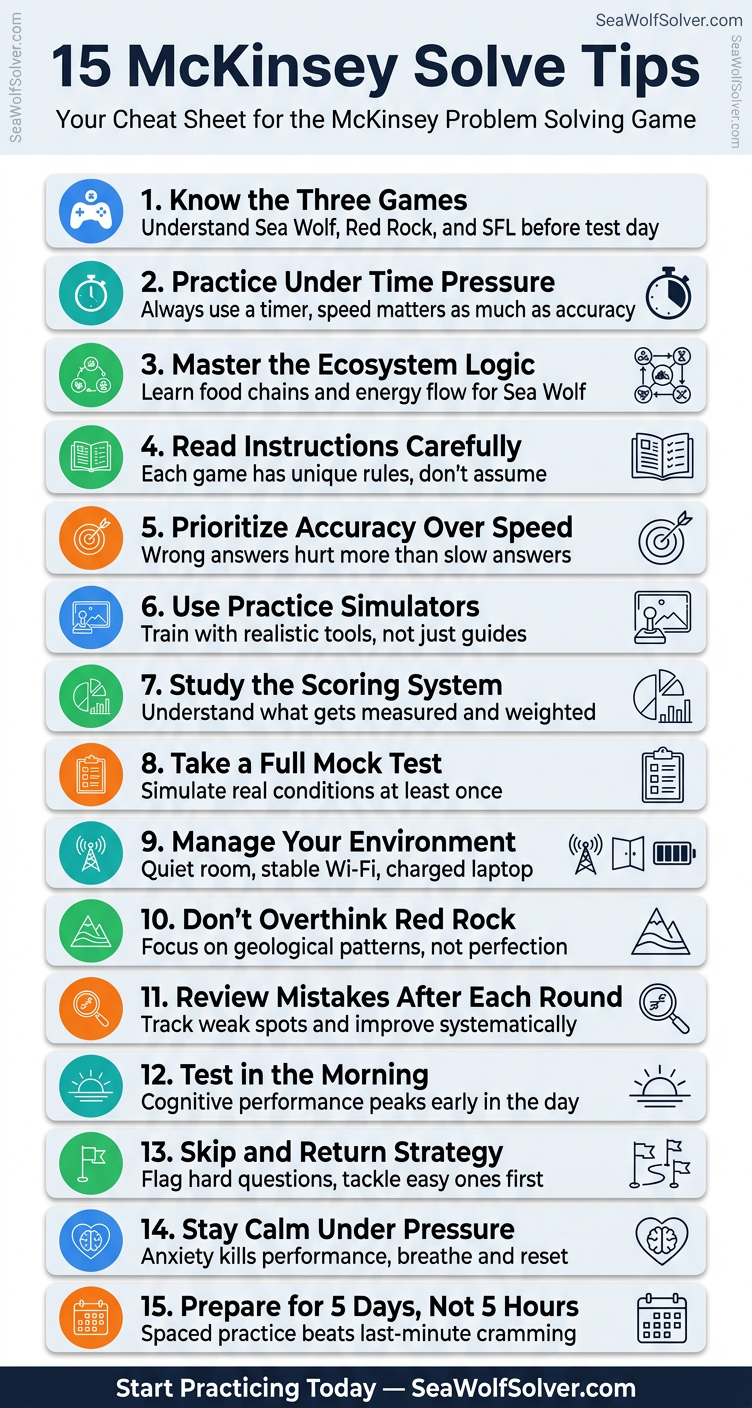
15 McKinsey Solve Tips That Actually Work in 2026
Actionable McKinsey Solve tips organized by game — specific strategies for Sea Wolf, Red Rock Study, and Ecosystem Building that go beyond generic advice.

Most McKinsey Solve tips you'll find online are useless. "Stay calm." "Manage your time." "Practice beforehand." That's not strategy — that's a fortune cookie.
The McKinsey Solve assessment (formerly the Problem Solving Game) eliminates roughly 60% of candidates before they ever speak to an interviewer. It assigns you two games — Sea Wolf and Red Rock Study — each with a ~35-minute time limit and percentile-based scoring against every other candidate taking the test worldwide.
Generic advice won't put you in the top 40%. These 15 McKinsey Solve tips will.
General Solve Strategies (Tips 1–5)
1. Treat the first 5 minutes as an investment, not a waste.
Most candidates panic about the clock and start clicking immediately. That's backwards. Spend the first 3–5 minutes of each game reading every piece of information the interface gives you — tooltips, data panels, instructions you'd normally skip. Candidates who rush through onboarding consistently make avoidable errors in the first third of the game that compound throughout. The assessment rewards methodical accuracy over frantic speed.
2. Your practice reps matter more than your practice hours.
Doing one simulation with a 15-minute debrief is worth more than four simulations back-to-back with no review. After each practice round, write down exactly where you hesitated, what data you ignored, and what you'd do differently. The Solve isn't testing how fast you learn the interface — it's testing whether you can extract the right pattern from noisy data. Reflection is where that skill develops.
3. Calibrate your pacing with checkpoint goals.
Don't just "manage time." Set concrete milestones. For a 35-minute game, you should know where you need to be at the 10-minute mark, the 20-minute mark, and the 25-minute mark. If you're behind at a checkpoint, you need to simplify your approach — not speed up. Speeding up increases errors. Simplifying your decision framework keeps accuracy intact while recovering time.
4. Assume the obvious answer is a trap.
McKinsey designed the Solve to differentiate analytical thinkers from pattern-matchers. If a choice looks obviously correct on first glance, pause. Check whether you're reacting to surface-level data or whether the underlying relationships actually support that choice. The assessment frequently presents options that seem right based on one variable but fall apart when you consider interactions between multiple variables.
5. Don't optimize — satisfice strategically.
Perfectionism kills Solve scores. You aren't scored on whether you find the single optimal answer; you're scored on the quality of your overall decision-making across the full game. Making eight good decisions beats making five perfect ones and three rushed ones. When you feel yourself agonizing over the marginal difference between two close options, pick the one with lower downside risk and move on.
Sea Wolf Game Tips (Tips 6–10)
The Sea Wolf game asks you to clean polluted ocean sites by selecting optimal combinations of microorganisms. Each microbe has properties like cleaning power, cost, and toxicity. Your job is to find combinations that maximize cleaning while staying within strict constraints — budget limits, toxicity caps, and microbe count restrictions. It looks like biology, but it's purely a constraint-based optimization problem. Here's how to approach it.
6. Identify the binding constraint first.
Before selecting any microbes, determine which constraint — budget, toxicity cap, or max number of microbes — will limit your choices. This constraint drives your entire strategy. Optimizing without knowing your bottleneck leads to infeasible solutions you'll have to redo.
7. Rank microbes by cost-efficiency.
Calculate each microbe's cleaning-power-per-unit-cost (or per-unit-toxicity) ratio. Start your selection with the highest-efficiency microbes and work down. This greedy-first approach gets you to a strong baseline solution quickly, which you can then fine-tune.
8. Satisfy all constraints before maximizing output.
Candidates often chase the highest possible desired score and forget about taking care to not include undesired traits. A solution that violates any constraint scores a -20% each for that site. Build a feasible solution first — one that meets every limit — then swap microbes to improve cleaning output incrementally. The Sea Wolf Solver can help you practice optimizing these calculations so the math becomes second nature during the real assessment.
9. Don't perfect one site at the expense of others.
You'll face multiple ocean sites in a single session. Spending 15 minutes optimizing one site to 98% while leaving two others at 60% is worse than getting all three to 85%. Allocate time proportionally and aim for "very good" across the board rather than "perfect" on one.
10. Practice the workflow, not just the math.
The Sea Wolf game tests your process as much as your quantitative skills. Use a simulator or the Sea Wolf Excel Solver to internalize the workflow: read constraints → rank microbes → build feasible combo → optimize. When this sequence is automatic, you'll save minutes on test day.
Red Rock Study Tips (Tips 11–13)
The Red Rock Study tests your ability to analyze geological and scientific data, identify patterns, and draw conclusions under time pressure. It's less about building something and more about reading data accurately and quickly.
11. Identify the question type before touching the data.
Red Rock presents different analytical challenges: some ask you to identify a trend, some ask you to find an anomaly, some ask you to determine causation from correlation. Spend 20–30 seconds identifying what kind of question you're answering before you look at any charts or data tables. A trend question requires you to scan for directional movement. An anomaly question requires you to scan for outliers. If you don't know what you're looking for, you'll waste time processing data you don't need.
12. Anchor on the axes and units before reading any chart.
This sounds basic, but under time pressure, candidates constantly misread data because they skip the axis labels. Is the Y-axis in thousands or millions? Is the X-axis showing years or months? Is the scale linear or logarithmic? A 15-second investment in reading axis labels and units prevents the kind of order-of-magnitude errors that tank your score. Build this into muscle memory during practice with the McKinsey Solve simulation.
13. Eliminate confidently wrong answers before evaluating plausible ones.
Red Rock Study typically gives you multiple-choice or multiple-select options. Instead of evaluating each option for correctness, start by identifying which answers are demonstrably wrong. Can you find a single data point that contradicts option C? Eliminate it. Can you show that option A assumes a relationship that doesn't exist in the data? Eliminate it. Narrowing from five options to two takes less cognitive load than trying to prove which of five options is definitely right.
Ecosystem Game Tips (Tips 14–15)
The Ecosystem Building game is the legacy format that McKinsey has phased out in favor of Sea Wolf, but some candidates still encounter it. The core mechanics involve constructing a food chain where species can sustain themselves within environmental parameters.
14. Prioritize species with the widest environmental tolerance.
In Ecosystem Building, generalist species — those that can survive across a broader range of temperature, terrain, and depth conditions — give you more flexibility as you build out the food web. When choosing between two species that fill a similar role, default to the one with a wider tolerance band. This reduces the chance that a single environmental variable disqualifies your chain later.
15. Validate every connection in both directions.
A common mistake: confirming that Species A eats Species B, but failing to check whether Species B can survive in the same environment as Species A. Every predator-prey connection requires bilateral validation — both species must be environmentally compatible and the caloric flow must be sufficient. Checking in only one direction is how candidates build chains that look correct but fail on simulation.
Bonus: What NOT to Do
Don't memorize species. The Solve randomizes species attributes across sessions. Memorizing that "the blue tang works well" from a practice round is meaningless — the blue tang in your actual test might have entirely different caloric values and environmental constraints.
Don't spend more than 90 seconds on any single decision. If you're stuck, make the best choice you can with available information and move on. The scoring algorithm weighs your full body of decisions, and one suboptimal choice costs far less than the three decisions you'll rush through if you burn time agonizing.
Don't ignore the tutorial. The tutorial screens contain game-specific parameters (caloric multipliers, terrain rules, scoring weights) that change between versions. Skipping the tutorial to "save time" means operating on assumptions that might not apply to your specific test instance.
Don't take the test cold. Candidates who complete at least 5–10 practice rounds on a realistic simulation before the real assessment score measurably higher. The interface itself has a learning curve, and you don't want to spend your real assessment climbing it.
Don't game the clock by clicking faster. The Solve measures decision quality, not click velocity. Rapid inputs with high error rates score worse than deliberate inputs with moderate pacing. The algorithm can tell the difference between a candidate who works quickly because they understand the system and one who clicks randomly hoping for partial credit.
Putting It All Together
The McKinsey Solve isn't a test you cram for the night before. The candidates who land in the top percentiles build their skills over 2–3 weeks of deliberate practice, treating each simulation round as a learning opportunity rather than a pass/fail checkpoint.
Start with the McKinsey Solve overview to understand the full assessment structure. Then use the simulation practice hub to apply these tips in a realistic environment. The Sea Wolf Solver and Red Rock simulations inside the Elite Bundle give you the closest possible replica of actual test conditions — so the real thing feels like just another practice round.
Frequently Asked Questions
How long should I prepare for the McKinsey Solve?
Most successful candidates spend 2–3 weeks practicing, completing 8–15 simulation rounds across both games. The key is spaced practice with reflection between sessions — not cramming 10 rounds into a single weekend. Aim for 2–3 practice sessions per week, each lasting 60–90 minutes including review time.
Can I retake the McKinsey Solve if I fail?
McKinsey typically enforces a 12–24 month waiting period before you can retake the Solve assessment. This makes first-attempt preparation critical. You generally get one shot per application cycle, so invest the preparation time upfront rather than treating your first attempt as a "trial run."
What score do I need to pass the McKinsey Solve?
McKinsey doesn't publish a fixed passing score. The Solve uses percentile-based scoring — your performance is ranked against all other candidates taking the test in the same period. Based on candidate data, scoring in approximately the top 35–40% is generally the threshold, though this varies by office and application volume.
Are the Sea Wolf and Red Rock Study games weighted equally?
McKinsey hasn't disclosed exact weighting, but candidate experience suggests both games contribute significantly to the overall assessment. Underperforming on one game is difficult to compensate for with a strong performance on the other. Prepare equally for both rather than banking on a single game carrying your score.